
Expert Tankless Water Heater Installation in Sarasota Florida
Tankless water heaters are often pitched as a simple upgrade. Endless hot water, lower energy bills, smaller footprint. What the pitch usually leaves out is that tankless isn’t a drop-in replacement. It’s a different kind of system. It needs more gas, different venting, and an annual maintenance routine that tank water heaters don’t require. And in Sarasota, where the water is very hard, that maintenance routine isn’t optional.
Legend Plumbing provides tankless water heater installation throughout Sarasota and the surrounding area. We assess your home’s infrastructure, explain what upgrades are needed, and complete the installation. For tank water heater service, see our water heater repair page. For whole-home water quality issues that affect the new system, our water quality services team can help.
Why Sarasota Water Changes the Tankless Equation
Scale Builds Inside the Heat Exchanger
Tankless units heat water as it flows through a heat exchanger — a set of narrow passages that warm the water in real time. Those passages are much narrower than the inside of a tank. When hard water minerals precipitate out of the water during heating, they coat the interior of the heat exchanger. Over time, the buildup restricts flow, reduces heating efficiency, and forces the unit to work harder.
Annual Descaling Is Required
Because of the scale issue, manufacturers require annual descaling to keep the warranty valid. The descaling process circulates a mild acid solution through the heat exchanger to dissolve mineral buildup. It takes about an hour and requires a flush kit that should be installed during the initial installation. In Sarasota’s water, skipping descaling shortens the unit’s life significantly.
Tankless Units Have Specific Water Quality Tolerances
Hard water is manageable with regular maintenance, but very high mineral content can shorten the unit’s lifespan even with descaling. Some homeowners pair tankless units with a water softener or whole-house filtration to protect the system. Our water quality services team can assess whether that’s worth doing in your home.
Infrastructure Requirements for Tankless
Gas Line Capacity
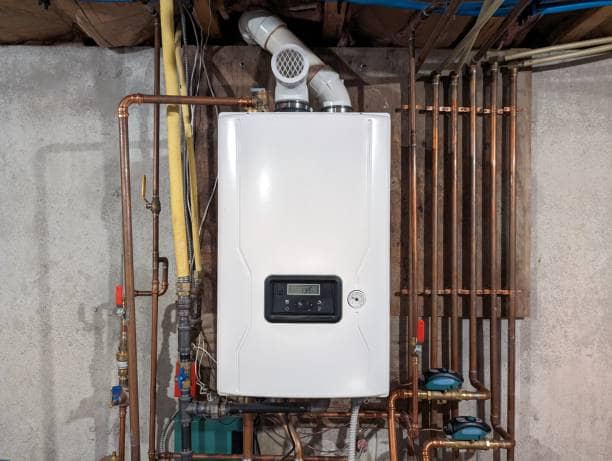
Most tankless water heaters are gas-powered, and they demand significantly more gas than tank units. A tank unit typically runs on a 1/2-inch gas line. A tankless unit can require up to 199,000 BTUs at full capacity — which almost always means upgrading to a 3/4-inch line. If the gas line is undersized, the unit won’t perform as designed.
Venting
Gas tankless units require dedicated venting. Non-condensing models need stainless steel venting that can handle high exhaust temperatures. Condensing models use PVC venting but produce acidic condensate that has to be drained or neutralized. The right venting depends on the unit type and the location of the installation.
Electrical Requirements
Tankless units need a dedicated electrical circuit for the control board, ignition system, and fan. If your home doesn’t have a circuit available near the installation location, one may need to be added.
Condensate Management (Condensing Units)
Condensing tankless units produce condensate that must be routed to a drain or neutralized before disposal. If there’s no nearby drain, a condensate pump may be needed.
Water Supply Line
Tankless units need adequate water flow and pressure to operate correctly. If your incoming water pressure is low, a booster pump may be required.
How Tankless Installation Works
Water Test and Assessment
We start by testing your water and checking the infrastructure. Gas line size, venting path, electrical availability, and household water demand all factor into the plan.
System Selection
Based on the assessment, we recommend the right unit. Size is critical — a tankless unit that’s too small won’t keep up with simultaneous hot water demand. One that’s too large wastes money and can short-cycle.
Infrastructure Upgrades
If the gas line is undersized, we run a new line. If venting isn’t in place, we install it. If the unit is condensing, we route the condensate drain. These upgrades are what make tankless installation more involved than a tank replacement.
Installation
The unit is mounted on the wall, connected to water and gas lines, vented, and powered. After installation, we test for leaks, verify the venting draft, set the temperature, and walk you through operation and maintenance.
Post-Installation Walkthrough
We show you how the system works, when to schedule descaling, and how to monitor for performance issues.
What Affects the Cost of Tankless Installation
Unit Type
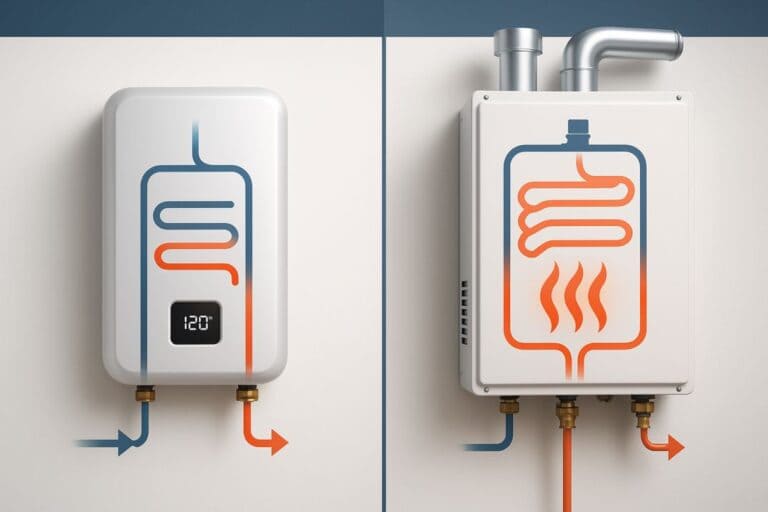
Non-condensing units cost less than condensing units. Condensing units are more efficient but require PVC venting and condensate management.
Gas Line Upgrade
If the existing gas line is undersized, running a new line from the meter to the unit adds to the cost. This is common in Sarasota homes where the original line was sized for a tank unit.
Venting
Non-condensing units need stainless steel venting, which costs more than PVC. Condensing units need PVC venting plus condensate handling.
Electrical Work
Adding a dedicated circuit adds cost if one isn’t available at the installation location.
Permits and Inspection
Tankless installation requires a permit in most jurisdictions. The permit covers a code inspection to verify proper gas connections, venting, and safety controls.
Contact us for an estimate based on your specific home and requirements.
Maintenance After Tankless Installation
Tankless is not “install it and forget it.” The annual maintenance routine matters.
Annual Descaling
Circulating a mild acid solution through the heat exchanger removes mineral buildup. This takes about an hour and requires a flush kit installed during the initial setup.
Filter Cleaning
Most tankless units have an inlet filter that catches debris. It should be cleaned or replaced annually.
Venting Inspection
The venting should be checked annually to confirm it’s clear and properly connected.
Performance Monitoring
If you notice longer wait times for hot water, fluctuating temperatures, or error codes, the system needs attention. In Sarasota’s water, these signs usually point to scale buildup.
Residential and Commercial Tankless
The approach differs between homes and businesses.
Residential
Home installations focus on right-sizing, gas line capacity, and maintenance access. Our residential plumbing services team handles residential tankless installation.
Commercial
Commercial buildings often need multiple tankless units configured for higher demand. Gas supply and venting requirements are more complex. Our commercial plumbing services team handles commercial installations.
Why Legend Plumbing Is the Right Choice for Tankless Water Heater Installation in Sarasota Florida
Expert Sizing Prevents Disappointment. The most common complaint about tankless water heaters—insufficient hot water—is almost always the result of improper sizing, not a flaw in the technology. We calculate your specific peak demand, measure your incoming water temperature, and specify a unit that will meet your household’s needs. We’d rather tell you honestly that a particular unit won’t work for your situation than install it and have you disappointed.
Licensed Installation, Full Warranty Protection. Tankless water heater warranties are contingent on professional installation by licensed contractors. Our installations meet every manufacturer requirement, every building code provision, and every safety standard. We pull all necessary permits, schedule and pass all required inspections, and register your warranty on your behalf. You get the full protection of the manufacturer’s warranty plus our workmanship guarantee. For system-wide upgrades, our Plumbing Repair specialists address any broader plumbing concerns discovered during installation.

AREA WE SERVED
Legend Plumbing provides tankless water heater installation throughout Sarasota County and the surrounding area. If you’re in one of these communities, we’re within reach:
Not sure if we serve your area? Reach out and ask.
Other Services We Provide
Along with tankless water heater installation, Legend Plumbing handles:
-
Water Heater Repair — tank and tankless systems
-
Water Heater Installation — tank water heater installation
-
Water Quality Services — testing and treatment for water issues
-
Plumbing Repair — general repairs for fixtures and pipes
-
Drain Cleaning — routine drain maintenance
-
Clogged Drain Repair — for stubborn clogs
-
Sewer Line Repair — damaged sewer lines
-
Leak Detection — finding hidden leaks
-
Slab Leak Repair — leaks under concrete slabs
-
Pipe Repair — damaged pipe repairs
-
Repiping Services — full and partial repiping
-
Hydro Jetting — high-pressure drain cleaning
-
Toilet Repair — toilet fixes and replacements
-
Faucet Repair — faucet repairs and installations
-
Garbage Disposal Repair — disposal fixes
-
Residential Plumbing Services — household plumbing
-
Commercial Plumbing Services — commercial plumbing needs
-
Emergency Plumber — urgent service when problems can’t wait
Questions About Tankless Installation in Sarasota
Is a tankless water heater really worth the higher upfront cost?
For most households, yes. While a tankless unit costs more to purchase and install than a standard tank, the energy savings of 30 to 50 percent annually, the longer lifespan of 20-plus years versus 8 to 12 years, and the benefit of endless hot water combine to deliver a positive return on investment. We provide a cost analysis during your assessment so you can see the estimated payback period for your specific situation.
How long does a tankless water heater installation take?
Most residential tankless installations are completed in one to two days. Installations requiring significant gas line upgrades, new venting runs, or electrical panel work may take longer. We provide a detailed timeline during your estimate.
Can a tankless water heater supply my whole house?
Yes, when properly sized. A gas tankless unit with sufficient flow rate can supply every fixture in a typical single-family home simultaneously. We calculate your peak demand during the assessment to ensure the unit we install will meet your needs. For very large homes with high simultaneous demand, multiple units can be installed in parallel.
Do tankless water heaters require maintenance?
Yes. Tankless units should be descaled annually to remove mineral deposits that accumulate on the heat exchanger. This is especially important in our region with its hard water. Our Plumber team can perform this maintenance, which takes about an hour and significantly extends the unit’s lifespan and efficiency.
How much space does a tankless water heater save?
A typical tankless unit mounts on a wall and is about the size of a small suitcase—roughly two feet tall, eighteen inches wide, and ten inches deep. This compares to a standard tank unit that occupies about nine square feet of floor space. Many homeowners reclaim an entire closet or utility room corner.
Can I install a tankless water heater outdoors?
Yes, in our climate, outdoor installation is an excellent option that eliminates venting requirements and frees up interior space entirely. We install the unit in a weather-protected enclosure on an exterior wall with proper clearance from windows, doors, and other openings.
Will I ever run out of hot water with a tankless unit?
No—that’s the defining advantage. A properly sized tankless water heater heats water continuously as it flows through the unit. As long as the total flow rate doesn’t exceed the unit’s capacity, you can run hot water indefinitely. You’ll never experience the cold shock of a depleted tank again.
Can you replace my tank water heater with a tankless unit?
Yes. We assess your existing gas line, venting, electrical service, and plumbing connections to determine what modifications are needed. Most homes can accommodate a tankless conversion with some infrastructure upgrades. Our Water Heater Repair team can also assess whether your current tank unit can be repaired if you’re not ready for the tankless upgrade.